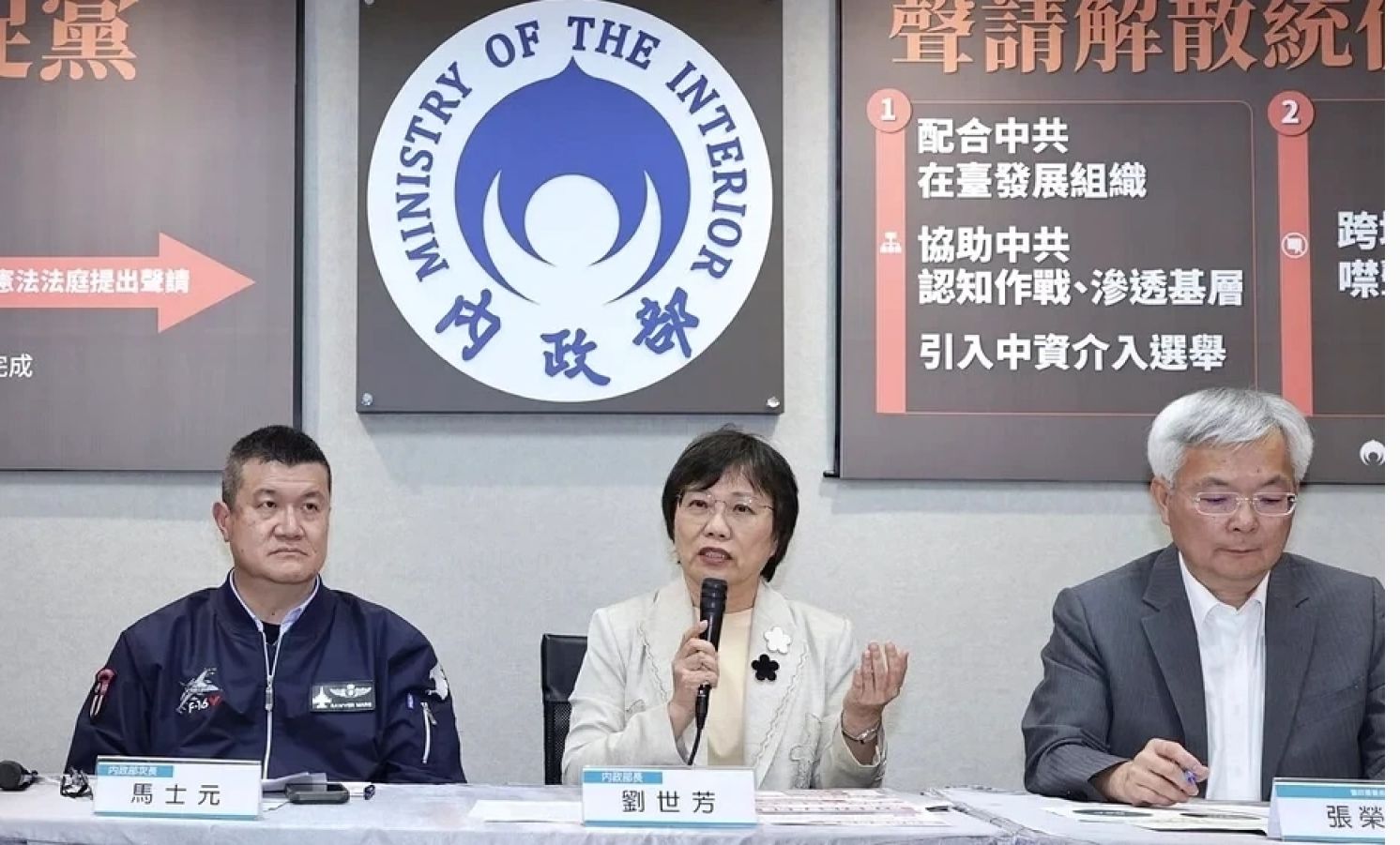
First Case of Political Party Dissolved by Government: Free Association Faces Dismantling
China Times Editorial, August 1, 2026
On July 30, the Ministry of the Interior (MOI) held a high-profile press conference announcing that it would petition the Constitutional Court to dissolve the Chinese Unification Promotion Party (CUPP). The move did not attract significant public attention in Taiwan, perhaps because the party advocates unification or because of its previously poor public image, leading many people to regard the matter as irrelevant to themselves. Precisely because of this, however, the MOI has chosen the easiest target by seeking to dissolve a legally established political party, thereby challenging the freedom of association guaranteed by the Constitution of the Republic of China.
The MOI cited three major grounds for claiming that the party endangers the existence of the R.O.C. or the constitutional order of liberal democracy. These include allegedly accepting instructions from Communist China to develop organizations in Taiwan, engaging in transnational repression to create an atmosphere that silences Taiwan's democracy, and the long-term involvement of numerous party members in organized crime. The MOI has clearly and deliberately blurred the distinction between the individual conduct of party members and the collective conduct of the political party itself. It has even relied on vague concepts such as "suspected" or "allegedly" to politically condemn cases that have not yet been conclusively determined through judicial proceedings.
Viewed from this perspective, the petition to dissolve the CUPP fully reflects the nature of political suppression. It can be regarded as an extension and manifestation of "Green Terror," further restricting political parties and individuals who advocate unification.
The Preamble to the Additional Articles of the R.O.C. Constitution explicitly states that they are enacted "to meet the requirements of the nation prior to national unification." Therefore, advocating political unification not only does not violate the Constitution but is, in fact, entirely consistent with it, as it pursues the integrity of R.O.C. sovereign territory. Moreover, in Constitutional Interpretation No. 644 issued in 2008, the Council of Grand Justices explicitly stated that advocating communism or advocating territorial separation falls within the protection of freedom of speech. This is not incompatible with Article 14 of the Constitution, which guarantees the people's freedom of association.
By seeking to dissolve the CUPP, the Democratic Progressive Party (DPP) administration is effectively using the case as a warning to political organizations and individuals that advocate unification. In reality, it is the DPP administration itself that demonstrates conduct which "endangers the existence of the R.O.C. or the constitutional order of liberal democracy." The DPP itself maintains a party platform advocating Taiwan independence. President Lai Ching-te has described himself as a "pragmatic worker for Taiwan independence." During the mass recall campaign, Minister of the Interior Liu Shyh-fang even remarked in a campaign speech that Lai Ching-te should become the "national leader of Taiwan.” Furthermore, the "Two States Theory"—which holds that the R.O.C. and the People's Republic of China are "not subordinate to each other"—has already become the established policy of the incumbent DPP administration.
If the government intends to petition for the dissolution of the CUPP, then should the DPP not also "eliminate all three sources of harm" by petitioning for its own dissolution in order to safeguard "the existence of the R.O.C. and the constitutional order of liberal democracy"?
For many years, Taiwan’s society has regarded unification as something to be feared and has largely dismissed pro-unification political parties and organizations. However, this is a matter of personal political preference and should not be elevated to the level of compulsory regulation by the executive branch or judicial enforcement. Otherwise, it would amount to overturning and trampling upon the constitutional principles of freedom of association. Petitioning to dissolve the CUPP marks the first step in the erosion of freedom of thought and freedom of association in Taiwan. After the Nazi Party successfully seized power in Germany in 1933, Adolf Hitler formally promulgated the Law Against the Formation of New Parties, after which other opposition parties were successively suppressed and dissolved.
Following the MOI petition to dissolve the CUPP, Kuomintang (KMT) Legislator Weng Hsiao-ling strongly criticized the move as an infringement upon freedom of association, emphasizing that it demonstrates the Lai administration's authoritarian tendencies and warning that the next step could be the dissolution of the KMT. Legislator Weng, who holds a doctoral degree in law from the University of Munich, is undoubtedly well-acquainted with the history of Nazi Germany. Her warning should not be dismissed as alarmist.
From: https://www.chinatimes.com/opinion/20260801002792-262101?chdtv